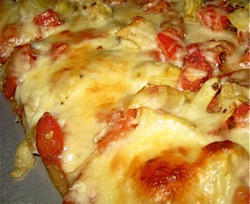
Monday Meal Planning: Thanksgiving Planning Begins Edition

It's about a month to go until Thanksgiving, so I'm starting to think seriously about what I'll put on the menu this year. Some dishes -- the herbed mashed potatoes and creamed corn, for example -- will likely remain unchanged because we love them as they are, but I like to vary things at least a little each year. I'm starting to test out new sides this week.

One big change: This year, we'll be deep-frying our turkey. We have a huge electric fryer in the shed, just waiting for its day in the clouded sun. I know it sounds terribly unhealthy, but considering how much butter or oil gets slathered on a roasted turkey, they're nutritionally similar.

We never eat the skin, anyway -- now maybe that truly horrifies you.

Monday
Chicken-fried steak with sawmill gravy
Whiskey-glazed carrots
Oil and vinegar slaw

Tuesday
Huevos rancheros with black beans
Salad

Wednesday
Chicken tikka masala
Steamed broccoli
Rice
Oil and vinegar slaw

Thursday
Patty melts
Roasted potatoes
Salad

Friday
Onion and banana pepper pizza
Salad

Saturday
Baked chicken
Corn
Apple, bacon, and caramelized onion dressing
Salad

Sunday
Spaghetti and meatballs
Garlic bread
Salad

Technorati Tags:
, ,

The Sky Is Falling! And Other News Bites

Not really, Chicken Little. But sometimes it feels that way when I see the grocery bill!

Poked and Prodded - Will the Bad Economy Force Unhealthy Changes to Our Diets?
I definitely feel the pull of ramen noodles these days, but we're sticking mostly to the plan of eating less meat and not buying junky snacks that waste our money.

Hungry Girl - Lunchbox Finds
I'm considering those Flatout wraps right now. I always find that tortillas split or spill when I try to make a wrap, plus one with reasonable calorie stats often doesn't hold much filling.

Health - Tea Is Trendy Again: Health Benefits Caught on Camera
Who knew tea was so good for your heart? Or even your teeth? I so need to drink more tea. It might prevent Alzheimer's, prevent cancer, and improve immune function, too. Apparently, tea is the miracle drug my family has been lacking. Make sure you stick with brewed tea to get the benefits, not wannabe bottled "tea."

Health - For Healthy Eyes, Think Broccoli and Kale, Not Carrots
More reasons to be eating your veggies, people! A dose of healthy fat alongside makes absorbing nutrients easier for your body, so don't think you have to stick with the steamer, either.

Health - How to Satisfy Late-Night Cravings
Soup is another way to go for a low-cal but filling nosh. I've also heard that something like easily digestible like saltines can help you sleep. I like a small bowl of cereal with skim milk sometimes myself.

Well Blog - Women’s Heart Symptoms Often Blamed on Stress
Stress does cause unpleasant symptoms, but apparently it's unwise simply to chalk up (or allow your doctor to chalk up) worrying symptoms to bad coping skills.

Have a great weekend!

Technorati Tags:
, , ,

What is . . . Energy Density?

You have two options for lunch today. Both offer a reasonable amount of calories for someone looking to slowly lose weight when served with a small side dish. Both offer a great punch of flavor. What will you choose?

A huge, two-cup bowl of minestrone? (220 calories)

or

One third of a Whopper with cheese? (253 calories)

Hmm.
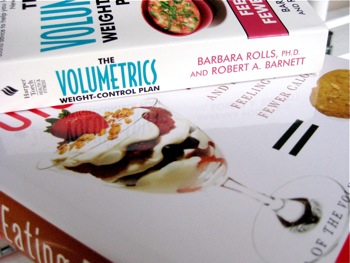
volumetrics.jpgWelcome to the world of energy density. It's the concept at the heart of the Volumetrics weight-control plan, but many diet plans employ the same basic idea. It's a concept that can help you learn to make healthy food choices that won't leave your tummy unsatisfied.

I write often about the advantages of replacing the salty or sugary snack foods with fruit. I've also discussed how important it is to eat plenty of beans. In my meal plans, I often include pasta with vegetables (whether they be broccoli florets stirred in or chunky tomatoes in a hearty sauce). But why? All of these strategies are based in part on evaluating the energy density of foods.

So what exactly is energy density, and what does it mean for those of us looking to reach a healthy weight? Barbara Rolls, nutrition professor at Penn State, writes in The Volumetrics Weight-Control Plan:

If you are trying to consume fewer calories, what is critical is the amount of calories in a given portion of food. A food that is of high energy density provides a large amount of calories in a small weight, while a food of low energy density has fewer calories for the same weight. With food of lower energy density, you can eat a larger portion for the same calories. (p. 15)


A food's energy density, then, is the ratio of its calories to its weight (as measured in grams). To calculate it, divide the number of calories on the nutrition label by the number of grams given for that serving.

Energy Density = Food Calories/Grams


That minestrone soup I mentioned above has 110 calories for a 241-gram serving. Its energy density, then, is a low 0.5 calories per gram. You can eat a lot of it without taking in too many calories.

The Whopper with cheese has 760 calories in one 315-gram sandwich. That gives it a high energy density of 2.4 calories per gram, which means you'll consume a ton of calories before you've eaten a satisfying serving.

It turns out that people don't decide how much food to eat based on calorie counts (surprise, surprise) but rather on food weight. Rolls found in her research that people tend to eat the same weight of food every day, no matter what kind of food it was.

That means your body would feel equally satisfied with either a pound of soup or a pound of cheeseburger. If you choose foods with low energy densities, then, you can continue eating your normal daily weight of food (so you won't feel hungry) and still drop pounds.

Calculating energy density does require a little math (albeit not as much as calculating Weight Watchers points!), but the good news is that a little knowledge about food components makes it easy to estimate which foods will have low energy density.

Many people know that a gram of fat has more calories (nine) than a gram of protein or carbs (four). Additionally, a gram of alcohol has eight calories, and a gram of water has none. None!

Water-based foods, such as most fruits, vegetables, and soups, have the lowest energy density. Foods high in fat, such as meats and full-fat dairy, tend to have high energy density. You can judge what foods are the best low-cal choices, then, by which are likeliest to be mostly water.

Another quick trick is to check the nutrition label:

  • If there are fewer calories than grams in a serving, the food has low energy density and can be eaten in abundance. Examples: squash, strawberries, oatmeal
  • If the number of calories is close to the number of grams, it has middling energy density and should be eaten with some restraint. Examples: pasta, potatoes, shrimp
  • If the number of calories exceeds the number of grams, you're looking at a food with high energy density, and you should eat it only in moderation. Examples: chips, hot dogs, cheddar cheese


Energy density is only one factor that should go into choosing what you eat; people cannot live by watermelon alone. However, you can use this stat to help you make healthy snack choices and to make your favorite dishes more waistline friendly. Give it a try today!

Next week, we'll look in a little more detail at using energy density to eat more of the foods we love for fewer calories.

Photo: Colleen Fischer

Technorati Tags:
, , , , , , ,

Healthy Highlights from October’s “Good Housekeeping”

New on Fit Fare this week, a look at a healthy dose of Good Housekeeping:

98ADA8F7-117C-4B62-9EAD-E31BDF2E9067.jpgFruits and vegetables can be fun for kids, and changing the menu at school and in the community can make significant difference in children’s health.
This month’s issue of Good Housekeeping featured an article about the successful Somerville, Mass., program to reduce childhood obesity. “Shape Up Somerville” is a far-reaching initiative that not only replaced junk food in local schools with healthy fare but also encouraged the whole community to pitch in to make the town a healthier place to live.


And just for you who've followed the article to my very own web site, here's a look at the healthy recipes featured in this month's issue:

Healthy Makeover French Toast: Whole-wheat bread, egg whites, no sugar, and low-fat milk make this breakfast treat less indulgent.

Cranberry-Almond Granola: Granola might be a bit high in sugar and fat for cereal, but it's packed full of whole grains. A half-cup serving provides plenty of nutrition for only 190 calories. I find a bowl with milk to make a terrific dessert, actually.

Cheese and Salad Pizza: Bless the heart of whoever created this rendition of salad pizza and elected not to put lettuce on it. That's so wrong. This pizza, though, looks like it might make it into one of my upcoming meal plans -- but I'll replace the cherry tomatoes with cheaper romas and likely resort to subbing cheese from a can for pecorino, much as I love the real deal.

On an aside: Store-brand grated parmesan costs more than $6 a pound, and pecorino romano from Costco costs maybe $7.30 a pound. Normally, that would be close enough to convince me to upgrade to the real deal (like the butter I stock up on when it's on sale vs. margarine), but to switch here I'd need to buy like a two-pound block at once. That's an upfront cost of nearly $15! I know I can store it so it won't go bad, but still . . . is it worth it?

Rotini with Marinara, Broccoli, Carrots and Peppers: The picture looks so appetizing that it could get me over thinking that pasta with carrots sounds weird. I tend to think of carrots as a starchy vegetable, so the idea strikes me as odd, just like potato pizza. Maybe I'm overreacting.

Corkscrews with Cheese, Tomatoes, and Peas: Yeah, cheese sauce is kind of rich . . . but I love it. I'd sub in skim milk.

Turkey Picadillo Tacos: I've never had picadillo. I'd never even heard of it until a couple of years ago. Anyone else tried it? Do olives, cinnamon, cumin, and raisins really all meld?

BBQ Chicken Tacos: Life on a super-tight grocery budget at a time when food prices have shot through the roof has made me realize just how much the recipes in the upper middle class-skewing publications I've long read over-rely on gourmet and convenience products. You know, it's not actually any easier to get your chicken off a rotisserie bird from the deli, and at $7.99 for a three-pound whole bird, it sure isn't cheaper.

Quick tip: Invest in a probe thermometer. It's a metal probe attached to a long, insulated wire that plugs into a digital display with an alarm that sounds when the temperature of your food hits a certain number. Not only will it save you uncertainty in telling when your roasts (like that Thanksgiving turkey) are done, it's a great for cooking chicken unattended (poached or baked) for recipes.

Photo: Colleen Fischer

Technorati Tags:
, , , , ,

Building My Pantry

pantry.jpgI unleashed a rant against pantries last week, but despite my negative view, I know that a pantry of some sort is a kitchen necessity. If you feel grumpy about my extremist pantry perspective after last week, I'm here now to soothe your tender feelings with my own cupboards' tale.

It took me a couple of weeks to get my pantry system nailed down, to be honest. I'm out of practice. My pantry in Europe was practically nonexistent, especially during my time in Prague, as the space for it was limited by the number of cans I could stack on the kitchen floor without tripping. Having a whole two cupboards, plus a full-sized fridge and freezer, seems like the height of luxury now.

I started out shopping with the idea that I would only buy items I knew I would cook with in the coming week, plus anything I use regularly that I noticed was on sale for a great price. It worked out OK; I ended up with just enough to get by with for a week, plus a bunch of whole-wheat pasta for $1.50 a box.

It became a little trickier when I started visiting Costco. Except for a few fresh items, such as bananas and lettuce, nothing you buy at Costco will conceivably need to be replaced within a week. It's a place where it's easy to go overboard with pantry stocking.

On my first trip, I grabbed only fresh items and perishable lunch fixings, both categories I knew would not lead me astray. I knew I would want to start buying other items there regularly, but I felt unsure of whether the space cost would be worth the price savings.

I came back armed with a pocket notebook to make a price list. It took a couple of hours, sure, but now when I go to my regular grocery store, I know what to pass on and buy at Costco instead.

I proceeded to stock up on food that I knew for sure I would use every week and thus go through well before it expired, such as whole-wheat pasta (the price at Costco is terrific), light yogurt, and meats.

In the end, I did pretty well on stocking up. I've been "shopping" my freezer and cupboards for very basic meats and dry goods that I bought in bulk or on sale now for about a month. I don't have a wide variety of food on hand because I plan each week on going to the store.

Right now, if you checked my kitchen, you'd find a good stock of items we eat every week here: ground beef, poultry sausage, chicken breasts, whole-wheat flour, and brown rice in the freezer; pasta, canned tomatoes, beans, white flour, and sugars in the pantry.

One area I neglected to plan well for is condiments and spices. I wouldn't realize until I started planning to make a recipe that I didn't have, say, Worcestershire sauce or almond extract on hand. Since we end up using condiments and seasonings like soy sauce in non-"recipe" applications regularly, I should have taken the time to really think through how I hit up my spice pantry day to day.

Next week, I'll dissect what I learned from this pantry-building experience and provide a few general suggestions to help you plan your own pantry.

Photo: Colleen Fischer

Technorati Tags:
, ,

Monday Meal Planning

Last week's pizzaIt's Monday again, which for me is shopping day. It's also a work day, which brings both benefits and drawbacks. For me, the reduced crowds at Fred Meyer and Costco outweigh having to shoehorn in another task on the first writing day of my week.
Have you ever visited Costco on a Saturday? I don't recommend it.

I'm attempting this week to reign in grocery costs even more than usual as the Costco bill felt a little extra painful last week (thanks to having to refill our stocks of yogurt, sandwich cheese, and dishwasher detergent). Thus, I'm sticking to meats I have stocked in the freezer and planning on a lot of pasta.

I'm also looking this week for meals that will pull together quickly, like sandwiches. Much as I try, I'm unlikely to get out of the kitchen in under an hour no matter what I make. Rachael Ray doesn't have to dig all her pans out of crowded cupboards, clean her produce, or wait for an electric stove to heat up. I do, and it cuts out a big chunk of the day if I'm set on making something ambitious, like chicken and dumplings.

Monday

Chicken and rice casserole with mixed veggies
Oil and vinegar slaw

Tuesday

Penne with broccoli in cheese sauce
Salad

Wednesday

Grilled Reubens
Oven fries
Salad

Thursday

Spaghetti with mixed-nut pesto and chicken sausage
Salad

Friday

Beef tacos in corn tortillas
Mashed black beans
Oil and vinegar slaw

Saturday

Pepperoni pizza
Salad

Sunday

Spaghetti with meat sauce
Salad

Photo: Colleen Fischer

Technorati Tags:
, ,

Picky Kids, Baby Eats, and More Hot Links

salad.jpgIt's good to get back on track with posting again. It's like normality has returned to my life. If only "normal" didn't get interrupted so frequently, I'd be totally back on schedule!

I may have disappeared for a couple weeks, but you can't keep me away from the Internet forever. Here's some stories that caught my eye recently.

New York Times - 6 Food Mistakes Parents Make
I'm not a parent, but I have been a teacher, so I know it's difficult to stick to your principles about the right way to do things with kids under pressure. I hope I'll be able to take a step back from the situation and keep calmly offering foods that elicit a "Yuck!" when I am a parent someday, but I'm not making any guarantees.

And on a related note:
New York Times - Momma, I'll Have Some of Whatever You're Having
You may or may not avoid growing a picky eater following this strategy, but you definitely will save some money steering clear of prepackaged baby foods.

Well Blog - Dieters Gain More Weight During Pregnancy
Parenting-related articles abound in the Times of late. The takeaway here is that pregnancy does not equal an unlimited pass for chips and ice cream. Eat a bit more, yes, definitely, but think of the baby and make nutritious choices.

Fit Fare - Wii Fit Diary
Check out Sarah Caron's ongoing story of getting fit with a Wii bit of help. (Surely I'm not the first to make that pun!)

Health - Eating to Control Cholesterol Levels
A succinct guide to the lifestyle changes you can make to lower your bad cholesterol without having to resort to a statin (and its accompanying side effects).

Eureka Alert - New study reveals higher protein breakfast may help dieters stay on track
You might call this the Egg McMuffin study, based on the multiple mentions of eggs and Canadian bacon, but it's the egg and pork industries behind this release, not McDonald's. Take it with a grain of salt (or hot sauce, if you prefer). (Via Hungry Girl.)

Poked & Prodded - Getting My Diabetic Day Off on the Wrong Foot
Continuing the breakfast theme . . . don't neglect to eat your breakfast! This post offers more evidence of the importance of packing said meal with protein as well as good carbs, if you found the last link less than convincing.

Photo: Colleen Fischer

Technorati Tags:
, ,

sp