Showing posts with label Beating the Odds. Show all posts

Calorie Counts Let Loose in the Real World

Let me direct you to my husband's blog, where he wrote recently about encountering New York City's calorie-posting law.

Thoughts on NYC « Springtime for Dubcek … and Slovakia!: "And it definitely affected my lunch decision. I had thought about just grabbing the Philly cheesesteak combo, but decided against it when I saw the nutritional damage would be more than 1,300 calories for the sandwich and fries (by point of reference, when I’m not traveling or celebrating the holidays, I try to limit my daily intake to 2,000 calories). The hot dog combo was about half that, with the small fries packing about 400 calories (and earning my blame for the indigestion I felt after eating) versus 297 calories for the hot dog."


Incidentally, just this past week we went shopping at Target and stopped in the store café for a snack (the popcorn and drink combo is a great deal at $1.50!). The store had put up a new price board since we'd last visited, and it now features calorie ranges for every item on the menu.

The popcorn, fortunately for us, turned out to be a reasonable two-person snack with only about 300 calories (if you get a calorie-free beverage), but some meals had surprising stats. The hot dog and chicken fingers meals are surprisingly good bets for a light meal, but the healthy-sounding sandwiches pack a hefty punch.

Having seen calorie count-enhanced menu boards, I now definitely support their implementation nationwide. Sure, we can make estimates now, and we can even do research before heading out if we feel especially motivated, but there's nothing like having that information right in front of our eyeballs right when we need it. I hope other restaurants follow Target's lead.

Observe and Learn

corn-chips.jpgA member of my family is on a doctor-recommended diet to lose weight and prevent the onset of type 2 diabetes. Basically, the doctor told this person to avoid all white foods: white bread, sugar, and potatoes. It's a simplified version of the low-glycemic, South Beach-style of eating.
Old habits die hard, though. When meat and potatoes are on the menu for decades, it's hard to switch to green vegetables and whole grains. Heck, it takes a whole lot of education to even get to the point where you can reliably identify which foods are healthy and which are not.

We all have to start somewhere.

And I've seen my relative start. Instead of a grabbing the whole bag of potato chips to munch on during the movie we watched, this person took a small handful of corn chips and never went back upstairs for seconds.

Sure, corn chips, made with refined corn, may not be as healthy a choice as whole-grain popcorn, but like I said: we all have to start somewhere.

I'm always glad to see someone start.

What Is . . . Basal Metabolic Rate?

calculator.pngThe key to weight loss is burning more calories than you consume. You can achieve this through consuming fewer calories and through burning more calories by exercising.
You can aid your efforts by counting calories in a food diary, to increase your awareness of what you eat and to make certain that you stay under the number of calories your body needs each day to maintain its weight.

But wait.

How do you know how many calories that is?!

That is where today's concept, basal (or resting) metabolic rate, enters the picture. Here's a quick definition from the Mayo Clinic web site:

Even when your body is at rest, it requires energy for the basics, such as fuel for organs, breathing, circulating blood, adjusting hormone levels, plus growing and repairing cells. Calories expended to cover these basic functions are your basal metabolic rate (BMR). Typically, a person's BMR is the largest portion of energy use, representing two-thirds to three-quarters of the calories used each day. Energy needs for these basic functions stay fairly consistent and aren't easily changed.


Basically, your BMR is the number of calories you would burn sitting on your butt doing nothing (and eating nothing) all day. Just being alive takes a lot of work, which is why it's possible for people to lose weight without exercise, why you turn all emaciated when you become ill and stop eating, and why you feel hungry even after hours of rest.

A big myth about BMR is that some people have high rates and thus are "naturally thin" while the rest of us with weight to lose have low metabolisms. While it would be comforting to believe your body size is in no way your own fault, unfortunately it's not true.

A couple factors affect your BMR:

1. Your height and weight. The bigger you are, the more calories your body needs to keep on breathing. It might seem unfair that tall people can eat more food without gaining weight than short people, but they are just as likely to overshoot the "full" mark and gain weight. It just takes them a few more bites to get that bloated feeling.

Concurrently, it's important to keep this factor in mind if you're losing weight as part of a group or partnership. A 1400-calorie diet might work well for an average woman who wants to drop pounds slowly, but it would be a dangerous crash diet for a tall, heavy man.

2. Your muscle tone. Muscle does burn more calories at rest than fat. Thus, regular strength-building exercise makes it a lot easier to maintain the weight loss you achieve through cutting calories.

Muscle tone also explains why other factors, such as gender and age, seem to affect our ability to achieve a healthy weight. Women generally have a higher body-fat percentage than similarly active men because the reproductive system requires it. Also, we lose muscle tone as we age -- though this may largely be because we move less the older we get, and so we aren't maintaining what we have.

All the more reason to exercise!

To determine how many daily calories you should shoot for in your weight-loss plan, you need to add your basal metabolic rate (as determined by your height, weight, and muscle tone/body-fat percentage) to the number of calories it takes your body to process the food you eat (a small percentage that isn't affected much by, say, all the celery you eat) and an estimate of the number of calories you burn through regular exercise.

Whew, that was a lot. Luckily, online calculators can do it all for you.

One tip: Don't overestimate the number of calories you burn through exercise. The total is usually lower than the display on your gym equipment indicates due to all those same factors that affect your BMR. Plus, you have to keep in mind that you'd be burning some of those calories anyway just by being alive during that 30 minutes. Exercise is for long-haul health, not short-term snacking permission.

Now, go forth and calculate!

Technorati Tags:, , ,

What is . . . Energy Density?

You have two options for lunch today. Both offer a reasonable amount of calories for someone looking to slowly lose weight when served with a small side dish. Both offer a great punch of flavor. What will you choose?

A huge, two-cup bowl of minestrone? (220 calories)

or

One third of a Whopper with cheese? (253 calories)

Hmm.

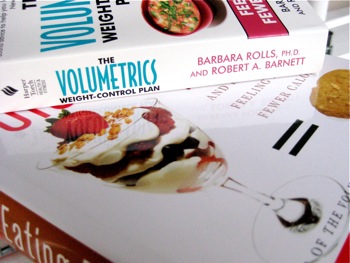
volumetrics.jpgWelcome to the world of energy density. It's the concept at the heart of the Volumetrics weight-control plan, but many diet plans employ the same basic idea. It's a concept that can help you learn to make healthy food choices that won't leave your tummy unsatisfied.

I write often about the advantages of replacing the salty or sugary snack foods with fruit. I've also discussed how important it is to eat plenty of beans. In my meal plans, I often include pasta with vegetables (whether they be broccoli florets stirred in or chunky tomatoes in a hearty sauce). But why? All of these strategies are based in part on evaluating the energy density of foods.

So what exactly is energy density, and what does it mean for those of us looking to reach a healthy weight? Barbara Rolls, nutrition professor at Penn State, writes in The Volumetrics Weight-Control Plan:

If you are trying to consume fewer calories, what is critical is the amount of calories in a given portion of food. A food that is of high energy density provides a large amount of calories in a small weight, while a food of low energy density has fewer calories for the same weight. With food of lower energy density, you can eat a larger portion for the same calories. (p. 15)


A food's energy density, then, is the ratio of its calories to its weight (as measured in grams). To calculate it, divide the number of calories on the nutrition label by the number of grams given for that serving.

Energy Density = Food Calories/Grams


That minestrone soup I mentioned above has 110 calories for a 241-gram serving. Its energy density, then, is a low 0.5 calories per gram. You can eat a lot of it without taking in too many calories.

The Whopper with cheese has 760 calories in one 315-gram sandwich. That gives it a high energy density of 2.4 calories per gram, which means you'll consume a ton of calories before you've eaten a satisfying serving.

It turns out that people don't decide how much food to eat based on calorie counts (surprise, surprise) but rather on food weight. Rolls found in her research that people tend to eat the same weight of food every day, no matter what kind of food it was.

That means your body would feel equally satisfied with either a pound of soup or a pound of cheeseburger. If you choose foods with low energy densities, then, you can continue eating your normal daily weight of food (so you won't feel hungry) and still drop pounds.

Calculating energy density does require a little math (albeit not as much as calculating Weight Watchers points!), but the good news is that a little knowledge about food components makes it easy to estimate which foods will have low energy density.

Many people know that a gram of fat has more calories (nine) than a gram of protein or carbs (four). Additionally, a gram of alcohol has eight calories, and a gram of water has none. None!

Water-based foods, such as most fruits, vegetables, and soups, have the lowest energy density. Foods high in fat, such as meats and full-fat dairy, tend to have high energy density. You can judge what foods are the best low-cal choices, then, by which are likeliest to be mostly water.

Another quick trick is to check the nutrition label:

  • If there are fewer calories than grams in a serving, the food has low energy density and can be eaten in abundance. Examples: squash, strawberries, oatmeal
  • If the number of calories is close to the number of grams, it has middling energy density and should be eaten with some restraint. Examples: pasta, potatoes, shrimp
  • If the number of calories exceeds the number of grams, you're looking at a food with high energy density, and you should eat it only in moderation. Examples: chips, hot dogs, cheddar cheese


Energy density is only one factor that should go into choosing what you eat; people cannot live by watermelon alone. However, you can use this stat to help you make healthy snack choices and to make your favorite dishes more waistline friendly. Give it a try today!

Next week, we'll look in a little more detail at using energy density to eat more of the foods we love for fewer calories.

Photo: Colleen Fischer

Technorati Tags:
, , , , , , ,

Changing My Diet for the Better

New post today over at Fit Fare:

beforeafter.jpgMy husband and I are seeing our families for the first time in about a year right now, and one comment we get right after each greeting goes something like, “Wow, you’ve really lost a lot of weight!”

The two of us devoted the last year to making serious changes in our eating habits in order to lose weight and reduce our risk for problems like diabetes and heart disease. We’ve seen many people struggle with these conditions, and that strongly motivates us to follow a healthy lifestyle to prevent their onset as much as we can.

Of course, that “Wow!” comment is eventually followed up by an almost timid question some time later: “How did you do it?”


It's only a summary of what's helped us, but it might help point you in the right direction if you're looking for some weight-loss inspiration. Come on back here to view the archives if you want more info!

A Jackpot within Reach

I tried and tried. Oh, did I try!

I bought nothing but light mayonnaise, skim cottage cheese, low-fat this, reduced-calorie that. I stocked my car with 100-calorie snack packs to ward off post-work hunger. I switched to healthier, whole-wheat pasta and bread. I bought diet books and tried to follow my magazines' eating plans. I even joined a gym!

It didn't matter. My weight, which had been inching upwards all through college, shot up dramatically. I gained more than 20 pounds in less than two years!

My lack of success fueled my stress levels, already high from simultaneously working and studying full time. Disappointed, I often gave up attempts to "diet" when I didn't see significant results, and then I drowned my sorrows in tortilla chips. Plus, I had poor sleeping habits, leading to a serious energy deficit at the end of each day. I coped with that by getting takeout and bingeing on energizing snacks.

Hey, what else could I do with the life I was given, right?

I figured it was impossible for me to lose weight and keep it off. I figured, dejectedly, that it was simply my destiny to be an overweight person. I worried about the deadly cardiac problems that might strike me, but I figured I was powerless to prevent them, the way things were going. I wondered if I might even face diabetes someday like millions of other Americans. Unsurprisingly, I also fretted over the way I bulged out of almost all of my clothes. Even with a crash diet, I barely squeezed into my own wedding dress.

After the honeymoon, I decided I needed to find out what was holding me back when so many others seemed capable of success. I researched healthy-eating and weight-loss strategies on the Internet. I brainstormed ways to incorporate more low-cal veggies into my diet. I purchased software that would give me nutritional information for nearly food imaginable and would track both my weight and calorie intake.

At the same time, I was facing a budget crunch. We were spending the year in Europe on a research grant, so we were faced with getting paid in the tumbling American dollar while having to buy food at European prices. I discovered the joys of meal planning, and I realized this strategizing could help my health goals as well as my pocketbook. Armed with information and newly acquired skills, I felt ready to make the permanent lifestyle change that leads to weight-loss success.

And it did.

I won't claim to have lost massive amounts of weight. Life certainly gets in the way sometimes: Vacationing in Munich led to meal after heavy meal of meat and potatoes, and it seems that nutritional labeling is optional for Eastern European processed foods. But even when you don't know what you're eating and you can't find (or even identify) whole-wheat bread at the grocery store, you can still lose weight and still stay on a healthy track. I may not have lost 50 pounds, but I have managed to undo the damage of the two years prior to my wedding. That feels good.

Pennies & Pounds will lead you through the journey I took from clueless to clued-in. You think you don't have time for your health? Consider the content here as your shortcut the strategies it took me months to research. Pennies & Pounds will share the information and ideas that convinced me that being overweight or obese is no one's destiny.

So I say to you: Don't buy into the idea that you're stuck with the size and the health stats you sport and that there's nothing you can do about it. Too much weight is a serious health problem that is possible -- and worth it -- to solve.

It's not as hard as you think. For one thing, you probably are doing some things right already, just like I was. Pat yourself on the back and keep it up! Pennies & Pounds will discuss these healthy habits and introduce you to others that will contribute to your success. Many are inspired by my research, but others stem from what I've learned through the mistakes I've made along the way.

We're talking habits here, though -- keep in mind that healthy habits are just that. They aren't magic tricks that will allow you to wake up a week from now 10 pounds lighter. Realistic expectations will keep you on track and keep you away from the disappointment that's the only result when you listen to supernatural-sounding advice. The site will also post reviews of books and other products that claim to help for people trying to get healthy. We'll separate the solid choices from those that offer a magical, change-free faux solution.

If you're at all like I was, then your problems are coming from not realizing how you are sabotaging your healthy efforts and thus holding yourself back from the health and size results you want.

For example: Consider Triscuits. I have always loved those woven-wheat crackers. Crunchy, salty, yum! And hey, they're made with whole grain! Sounds like a great healthy snack, right? Maybe -- if you're willing to eat only one serving. Of seven crackers. Seven! That means each cracker has about 20 calories. That's twice as many per piece as potato chips. Eat 10 crackers as a snack? There's 200 calories down the drain. Sit in front of the TV with the box? Probably a good deal more than 200 calories.

Pennies & Pounds will teach you about strategies such as keeping a food diary and planning meals that will help you find and nail your diet's problem areas.

There is hope for achieving a healthy lifestyle. Not only do you have the benefit of your own smarts applied correctly, but research into healthy eating happens all the time. The site will track and provide links to articles elsewhere that inform and inspire.

Losing weight and regaining your health is a long process, but it is possible, practical, and utterly doable. If I can do it, and millions of other can do it, then you, too, can learn to make a permanent lifestyle change that will make you feel better with each passing day, not worse. Don't lose hope, and don't give up! Pennies & Pounds is here to help.

Technorati Tags:
, , ,

sp